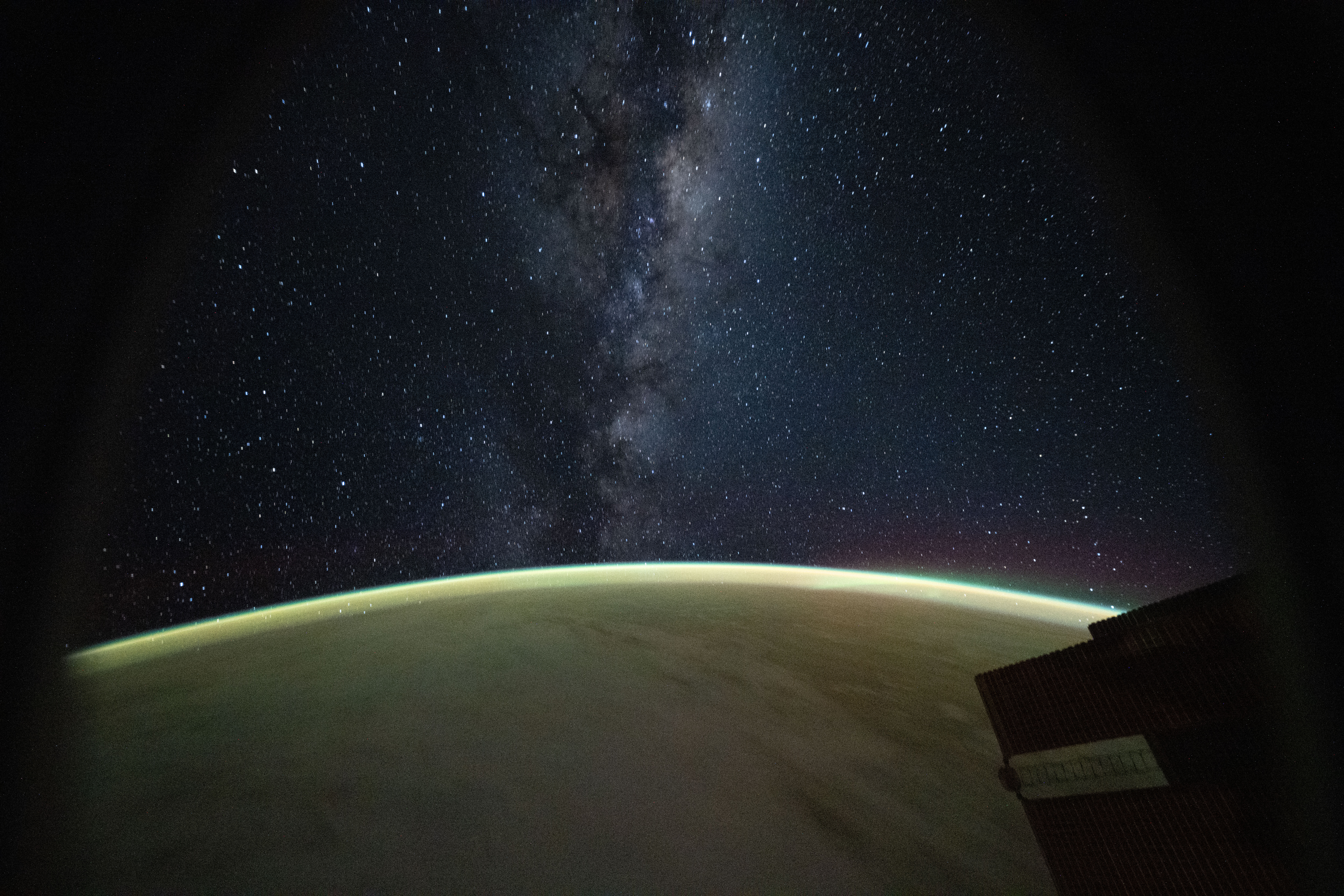
On April 13, 2026, NASA astronaut Chris Williams captured a breathtaking image from aboard a SpaceX Dragon capsule docked to the International Space Station (ISS). The photograph shows the majestic Milky Way rising above Earth's atmosphere, which glows with a faint, ethereal light known as airglow. This image is not only visually stunning but also serves as a reminder of the unique vantage point the ISS provides for observing our planet and the cosmos.
What Is Airglow?
Airglow, also called atmospheric glow, is a natural phenomenon that occurs when atoms and molecules in the upper atmosphere release energy in the form of light. This process happens in two primary ways:
- Excitation by sunlight: During the day, sunlight energizes atoms and molecules. At night, these particles shed the excess energy by emitting photons—particles of light.
- Ionization and recombination: Sunlight can also ionize atoms, stripping them of electrons. When these ionized particles later capture a free electron, the resulting recombination releases a photon.
In both cases, the photons are emitted randomly, creating a diffuse glow that appears faint to the naked eye but can be vividly captured by sensitive cameras on the ISS. The color of airglow varies depending on the altitude and the type of molecule involved—green light typically comes from oxygen at around 90–100 km, while red light originates from oxygen higher up (300 km) and yellow or orange from sodium.
How Is Airglow Different from Auroras?
Airglow is often compared to auroras, but the underlying energy sources are distinct:
- Auroras are caused by high-energy particles from the solar wind interacting with Earth's magnetic field and atmosphere. These particles are funneled toward the poles, creating vibrant, dynamic curtains of light.
- Airglow is energized by ordinary solar radiation—the same sunlight that warms our planet. It occurs globally at all latitudes, though it is most visible with long-exposure photography.
Both processes involve the emission of photons, but airglow is a continuous, calm glow, whereas auroras are sporadic and intense.
Capturing the Cosmos from the Space Station
Photographing the Milky Way and airglow from the ISS requires careful planning and advanced equipment. Astronauts like Chris Williams use specialized cameras with high sensitivity to low light, often mounted on a SpaceX Dragon capsule's windows or inside the station's Cupola observation module. The ISS orbits Earth at an altitude of about 400 km, providing a clear view of both the planet's limb and the deep space beyond.
The image taken on April 13, 2026, was likely a long-exposure shot, which allows the camera to gather enough light to reveal the starry band of the Milky Way while also capturing the subtle colors of airglow along the horizon. The Dragon capsule, with its large windows, offers an unobstructed view that is ideal for such astrophotography.
Why Study Airglow?
Beyond its aesthetic appeal, airglow has significant scientific value. Researchers monitor airglow to study the composition and dynamics of the upper atmosphere. For example:
- Atmospheric temperature and density: The brightness and color of airglow vary with temperature and the concentration of atoms like oxygen and sodium. Changes in airglow can indicate shifts in atmospheric conditions.
- Waves and tides: Airglow is sensitive to atmospheric gravity waves, which propagate upward from the lower atmosphere. These waves influence weather patterns and space weather.
- Space weather effects: Airglow can be enhanced during geomagnetic storms, providing insights into how solar activity affects Earth's upper atmosphere.
The Future of ISS Observations
As the ISS continues its mission, astronauts will keep capturing images and data on airglow. Instruments like the VISual Airglow and Aurora System (VISAAS) and the Atmospheric Space Interactions Monitor (ASIM) are already on board, recording ultraviolet and visible emissions. These studies help refine models of atmospheric circulation and chemical processes.
Chris Williams' photograph is a testament to the incredible opportunities the ISS offers for both scientific discovery and public inspiration. With upcoming missions from SpaceX and other commercial partners, the tradition of sharing stunning views from orbit will continue to enrich our understanding of our planet and the universe.